
Discovering the Business of Experience
Customer experience has become one of the most overused and misunderstood terms in the business world.
For many companies, it remains a dashboard, not a discipline, which is why a true customer experience performance system is crucial.
I have never believed that customer experience should be limited to dashboards, journey maps, or surveys. My focus has always been on using that data to improve processes, policies, and products in ways that drive revenue growth and increase customer lifetime value.
Zack Hamilton’s The Experience Performance System did not change that view. It refined it and gave me words to describe what effective CX leaders have been doing for years.
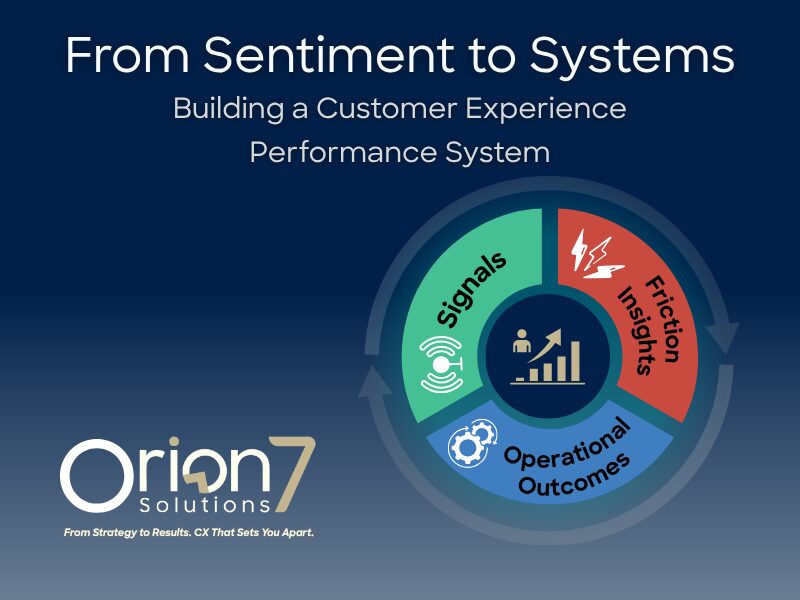
From Sentiment to Systems: Building a Customer Experience Performance System
For years, I have believed that customer experience is not a department or a report. It is the system that holds a company together, determining how decisions are made, priorities are set, and people are rewarded for doing what is right for both customers and the business.
However, I will admit that I have often struggled to articulate it in a way that resonates with executives.
Zack’s book changed that.
He framed CX as a performance system rather than a reporting function.
Most CX programs still orbit around survey cadences, dashboards, and governance committees. The Experience Performance System (EPS) completely flips that model.
It may not be the new Bible of CX, but it might just be our Book of Common Prayer.
It gives language, rhythm, and structure to what many of us have been practicing for years without a shared vocabulary.
EPS is designed like a business engine, not a reporting cycle.
It takes in customer and operational signals, turns them into strategic friction, aligns that friction with business levers, and drives execution continuously.
It is a flywheel, not a cycle, one that builds momentum around outcomes that actually matter. This is the foundation of a customer experience performance system in action.
Zack outlines twelve operational models that bring this to life:
The Signal Model captures real-time data.
The Friction Model converts it into prioritized blockers.
The Prioritization Model aligns those blockers with KPIs and quantifies tradeoffs.
The Case Maker™ Model builds one-page business cases linking CX to P&L impact.
The Champion Model activates internal advocates.
The Close Plan Model maps milestones and blockers to accelerate execution.
The Pod Model replaces static governance with agile, outcome-driven teams.
The Scaling Model codifies what works across functions.
The Influence Model builds CX power without authority.
The Feedback Loop Model captures learning from every sprint.
The Employee Signal Model connects frontline insight to system-level improvement.
And the Agentic Model marks the next frontier, where human-led CX evolves into AI-augmented orchestration.
It is a comprehensive architecture for managing customer experience, akin to a business system, rather than a set of disconnected initiatives.
Turning Insight Into Impact
Reading it felt like someone turned on the lights.
It confirmed that the direction I was already heading was part of a larger shift in how customer experience is evolving.
Since founding Orion 7 Solutions earlier this year, I have been developing a suite of CX frameworks built around that same belief: that experience should be managed like a customer experience performance system.
Those include the Customer Difficulty Index (CDI™), the Experience Friction Index (EFI™), and the Predictive Experience Revenue Impact (PERI™).
While they were developed independently, they share many of the same fundamentals that The Experience Performance System articulates.
CDI™ quantifies the human effort inside interactions.
EFI™ measures systemic friction and prioritizes where it costs the most.
PERI™ ties those improvements directly to revenue and retention outcomes.
Together, they align with the spirit of what EPS represents: connecting signals, reducing friction, and turning experience into measurable business performance.
That is not to say the emotional side does not matter. It does.
But emotion without execution is theater.
Performance systems turn it into business impact.
At Orion 7, we help companies operationalize customer experience as a true business discipline.
We translate customer insight into leadership alignment, process design, partner accountability, and financial outcomes.
That is the space where I have spent my career, from the contact center floor to the executive boardroom, building systems that connect what happens between customers and employees to what shows up on the balance sheet.
Zack’s Experience Performance System gave language to what many of us have practiced instinctively.
Our work at Orion 7 focuses on operationalizing those same principles inside organizations, aligning people, process, and technology so performance follows experience by design.
Because here is the truth:
CX is not about making customers happy.
It is about making companies healthy.
And that starts with rethinking experience as a business framework that builds, sustains, and grows value across every function.
What Comes Next
This shift, from sentiment to systems, is the foundation for everything we will explore in the next few CX Factor articles.
Because when companies stop measuring feelings and start managing performance, customer experience becomes the most reliable growth lever they have.
This is where Orion 7 fits in.
We help organizations move past dashboards and start designing systems where the customer experience performance system becomes the foundation for measurable growth.
If you’re ready to build the business of experience, not just talk about it, let’s connect.
👉 Book a 15-minute strategy call.
Explore more insights in The CX Factor Series.